03 February 2017

Behavior Management For Children with Behavioral Problems

Let me share with you this writing that I submitted (Feb. 25, 2016) to our UP SPED teacher in one of the many assignments (3-5 times per week) she gave us, not to mention the weekly discussions we had to participate in as part of our CCSN course requirement. 

What behavior management technique works for a child with behavior problems? 

There are several factors that may cause children to misbehave. Misbehaviors could be a result of the child’s emotional status, socio-economic standing, or could be from a medical condition or disability. The disability, however, may not always provide a reasonable excuse for improper behaviors. Whatever the behavior, it should be contained and managed for the best welfare of the child. Behavior management entails setting concrete boundaries to control the behavior, reduce the anxiety, prevent disruptions, provide a feeling of emotional security for the child, especially for behaviors that have a tendency to escalate into physical aggression — hurting others and self-injury. We (teachers, parents, caregivers) need to establish very clear and precise rules concerning what we expect and desire the child should do and how this child should act/behave when a stressful situation occurs. Remember though that rules have to be founded on what is doable and appropriate for the child, particularly those with disability or special needs.

First step towards effective behavior management would be to identify the reason for the misbehavior. And from there, we could try and fit a solution. It is also important that we first ask ourselves: Which came first? — the behavior or some frustrating or aversive circumstance that could have caused it? We have to understand why challenging behaviour happens and what purposes they serve. It could be to seek attention; could be from communication difficulties (inability to convey messages, needs or wants because of the child’s deficit in understanding or inability to use language); or could be from environmental factors that cause sensory issues to the child.

In the course material, Behavior Management of Children with Special Education Needs in the Regular Classroom, effective techniques used are buddy system, socialization opportunities, teaching appropriate social responses and behaviors, re-directing the child’s focus, establishing routines, clear and simple class rules, good class schedule, well-prepared lessons, learning contracts, motivating classrooms, and pull-outs for students with excessively disruptive and violent behaviors.

In this assignment, I would like to specifically tackle on CLASS RULES.
A clear and simple class rule could be: Good behaviour gets a reward (the use of positive reinforcement), and bad behaviour gets a consequence (the use of consequence).  

The Use of Reinforcements:
Reinforcement is an incentive which follows a behavior and is reliant upon such behavior. It increases or decreases the likelihood of repetition of a behavior.

First, catch the child being good. How is that possible? He is always misbehaving!
Observe the child carefully and maybe we will be surprised to find out that he is actually behaving most of the time but we just failed to notice because we expected negatively on him. Ignore inappropriate behaviour and pay attention to good behaviour. Praise or reward him for the behaviour.

Positive Reinforcement
Positive reinforcement can encourage the possibility of an agreeable or disagreeable behavior. For instance, if a student finds that whining could get attention, the attention provides positive reinforcement that raises the chance that the student will prolong the whining behavior.
Reinforcement could be positive or negative reinforcement.

Reinforce positive behavior through the use of social reinforcers or expressions of appreciation and praise. Remarks such as "Good job," "I can tell you are working really hard," "You're nice", written approval "Super", and approval expressions such as nodding one’s head, smiling, clapping, and a pat on the child’s back are all really helpful reinforcers.
Activity reinforcers are also very useful and constructive for students. Giving students the chance to take part in chosen activities, for example games or computer time, is especially influential, particularly if the reinforcement permits selecting a classmate to participate with in the activity. This is a social reinforcement from the partner.
Tangible reinforcers are effective too. These include food, toys, balloons, stickers, and awards. However, food and toys must be used sensibly. If a student has problems with weight, parents may disallow the use of food as reinforcement. Toys, on the other hand, might make classmates jealous. Rewards and awards may be in the form of certificates, an exhibition of work, and written commendations on the student’s progress to be sent home to parents.
Token reinforcement entails awarding points or tokens for appropriate behavior. In itself, this reinforcer may have only a slight worth, however this could be swapped for something valuable or important to the student.

Negative Reinforcement       
Negative reinforcement is frequently confused with punishment. Punishment is the use of aversive stimuli to decrease the probability of a behavior recurrence. Negative reinforcement is the taking away of aversive stimuli to increase the chance of a behavior recurrence. Negative reinforcement can be really powerful, particularly in creating an environment that feels secure to a student. This is often more expectedly experienced than tangible reinforcement. As with any reinforcement type, it is essential to partner negative reinforcement with social reinforcement.

Here is an example of negative reinforcement: The teacher tells the students that she will remove five story problems if the class time is maximized to do their math work properly. Eliminating the story problems from the math homework negatively strengthens appropriate behavior by taking away the unwanted stimuli of a lengthy homework assignment.
  
The Use of Consequences:
We must set expectations and explain what the consequences will be when these expectations are not met. A consequence needs to not better than what the misbehaving child is currently experiencing so he will be motivated to want to modify the behavior.
Example: A consequence may be presented to a child as a choice. A teacher might say: “I have asked you twice to work quietly. If you continue to talk, you will have to work at another table.” This is a way of holding the child responsible for his behavior. Consequences should be consistent, promptly applied, reasonable and related to the behaviour concerned.

However, before negative consequences are implemented, appropriate and rich incentives should first be developed to reinforce desired behavior. It is essential to give much encouragement, praise and nurturance as children can be easily discouraged. When negative consequences are administered, they should be given in a fashion that does not embarrass or put them down. In addition, it is important to keep in mind that the rewards used with these students lose their reinforcing power quickly and must be changed or rotated frequently.


Whatever reinforcement, reward, punishment or consequence is used with children, it should always be paired with a social reinforcement, such as praise and encouragement.

Reinforcers in the form of stickers have proved effective as incentive and behaviour modification tool for my son, Miggy. Below are pictures of him with his stickers which has actually developed into an obsession.
(Miggy, now 14 yrs. old, diagnosed with autism at age 2yrs/9mos in 2005) 


01 February 2017

Assisting a Child with Special Needs

How does it feel to assist a CSN?

Allow me to answer this question in two ways — as a mother and as a teacher.

As a mother of a CSN:
My first reaction? Scared! It is like stepping into a world unknown. What I read technically in books is just so different from the real thing. When my son was diagnosed with autism in 2005 (he was 2 years/9 months old then), I was pushed into an unexpected situation with no time to think, no time to mourn, and no time to catch my breath. Scary! Overwhelming! Tiring! And later, thankful. I felt lucky to be gifted this experience, thankful for this opportunity for only the chosen few. Living with a CSN, assisting and providing the best possible care, addressing his every need, and trying every possible intervention and even the never-before-tried strategies, gave me hope in the unknown, faith in myself and in what I can do and the length I would go just to make him better and fit into society.

As a teacher:
It feels rewarding to see the child unlock his world, and allow and trust me to get into his world where no one has ever had access. Through my years of experience in assisting children with special needs, I learned that getting through to them emotionally opens their mind academically. I not only help the children but their families as well. I make them see that life is going to continue for him after the diagnosis, that there is something to look forward to, that is the CSN’s independent living and possible employment, and a better placement in an accepting society. And on its fruition, it would really feel SO GOOD knowing that I was a part of it.


Every experience with a CSN will always humble me down and remind me that “Nobody is perfect,”  — each one unique in his own little way. 

25 February 2016

02 February 2016

Legal Protection for Filipino CSN

How much legal protection does the Filipino child with special needs have?

The state has an obligation to provide reasonable accommodation and protection measures to persons with disabilities. Here are some legal protection measures as contained in the following laws which are commonly useful: 

1. Republic Act 7277 – Magna Carta for Disabled Persons (I always have a copy of this in my bag, in case of emergencies or the need to provide proof for privileges for my special child.)
- an act providing for the rehabilitation, self-development and self-reliance of PWDs and their integration into mainstream society.
- rights and privileges for disabled persons, such as employment, education, health and social services, telecommunications, accessibility, political and civil right.
- discrimination against PWDs; housing program; tax incentives and exemptions
2. Administrative Order No. 35 – Annual observance of the National Disability Prevention and Rehabilitation Week every 23rd of July, the birthdate of the sublime paralytic, Apolinario Mabini, by all government departments, bureaus, offices, corporations, institutions, state universities and schools.
            - through promotion and implementation of activities/programs for the welfare of PWDs;
            - to stimulate public awareness on all matters and issues involving PWDs and encourage
            every citizen to take active responsibility in uplifting their economic and social
            conditions as well as recognizing the abilities of our brethren with disabilities;
            - to encourage the PWD sector in taking pro-active roles in nation building.
3. Batas Pambansa Blg. 344 – An Act to Enhance the Mobility of Disabled Persons by Requiring
Certain Buildings, Institutions, Establishments and Public Utilities to install Facilities and Other Devices
- through the use of UD (Universal Design) principles in architectural facilities or structural features, such as a separate wheelchair-accessible entrance and a gently sloping ramp; wide and automatic sliding doors; restrooms that can address the needs of all users; high-contrast, large-print directional signs; lever handles rather than knobs for doors; non-slip walking surfaces.
4. DILG Memorandum Circular No. 2009-129 - Compliance To The Issuance Of Identification
Cards And Purchase Booklets For Persons With Disability (PWDs)
    DOT Memorandum Circular No. 2011-04 – Special discounts to persons with disabilities
            - the entitlement of at least twenty percent (20%) discount to PWDs in the following
institutions and establishments: hotels, restaurants, recreation centers; theaters, circuses, carnivals; medical and dental facilities and services; land, air and sea transportation; educational institutions and services.
5. Executive Order No. 385 – Creating a task force to address the concerns of PWDs
- a body that shall formulate strategic interventions and provide expeditious response to address the immediate concerns of PWDs
    Executive Order No. 437 – Encouraging the implementation of CBR Community-Based
Rehab for PWDs
-        Affordable or free health and social services for PWDs; Accessible to all PWDs

Getting laws implemented and fighting for equal rights is an ongoing struggle for many PWDs. Accessibility, availability and affordability of services are often a problem. Some schools may have policies related to discrimination, harassment, or bullying, however some are not strictly implemented.

Some establishments, particularly restaurants and drug stores do not honor the PWD card.

In terms of employment, there should be a stricter implementation of the laws and policies. In Section 5 of Republic Act (RA) No. 7277, it says that government organizations engaged in social development such as DSWD, DOH, DepEd, etc., are required to reserve 5 percent of all their casual, emergency and contractual positions for PWDs. I just hope this really applies — and that it’s not ningas kugon, palakasan, or papogi points.


I hope the this administration will make possible financial assistance to ALL Filipino PWDs and not just the senior citizens. Medications, rehab services and therapies, assistive devices and SPED services for PWDs are costly, we all know that, and oftentimes only the financially able are able to avail and sustain these. Very sad but true.

10 October 2015

Go Red Warriors


The Red Warriors (Miggy's team) won two champion trophies, for Cheer Dance and Field Demo in the Sports Intramurals held at the Lualhati Sports Complex.


01 September 2015

Water gun

"Miggy," I called. "Can you please help me water the plants?"
And obedient as we all know he is, he ran inside the house, took his water gun and...


24 August 2015

Ho-Ho-Ho in August

With nothing to do these past three long, chilly, stormy brownout days, we just couldn't resist the pull and spirit of the BER months. Ho-Ho-Ho!


06 August 2015

Teaching thru Repetitions

Autistics are visual learners. They learn effectively through repetitions.
My apologies for the label. It may be offensive for some to address them as "autistic." Others prefer the more acceptable "persons with autism" (PWAs). Me, I don't mind at all. I'm just being true, accepting and open. We all should be.


 Notice that he wrote the items thrice.


And this is how I teach him spelling. Again through repetitions.

21 July 2015

Thou shalt clothe the naked

How about a little fun post today?

I was packing away some of Miggy's toys and I found this. I had a good laugh!
And wow, Miggy knows that private parts should be covered!

Thou shalt clothe the naked.


10 July 2015

Mamon-it-yourself

It is very seldom that his sister is here with us. She studies in Manila, that's why. So I make it a point that they do an activity together every time she's home.
I bought this limited edition of Monde Mamon two weeks ago and waited for Ate Clarisse.


Well, isn't that cute?

13 May 2015

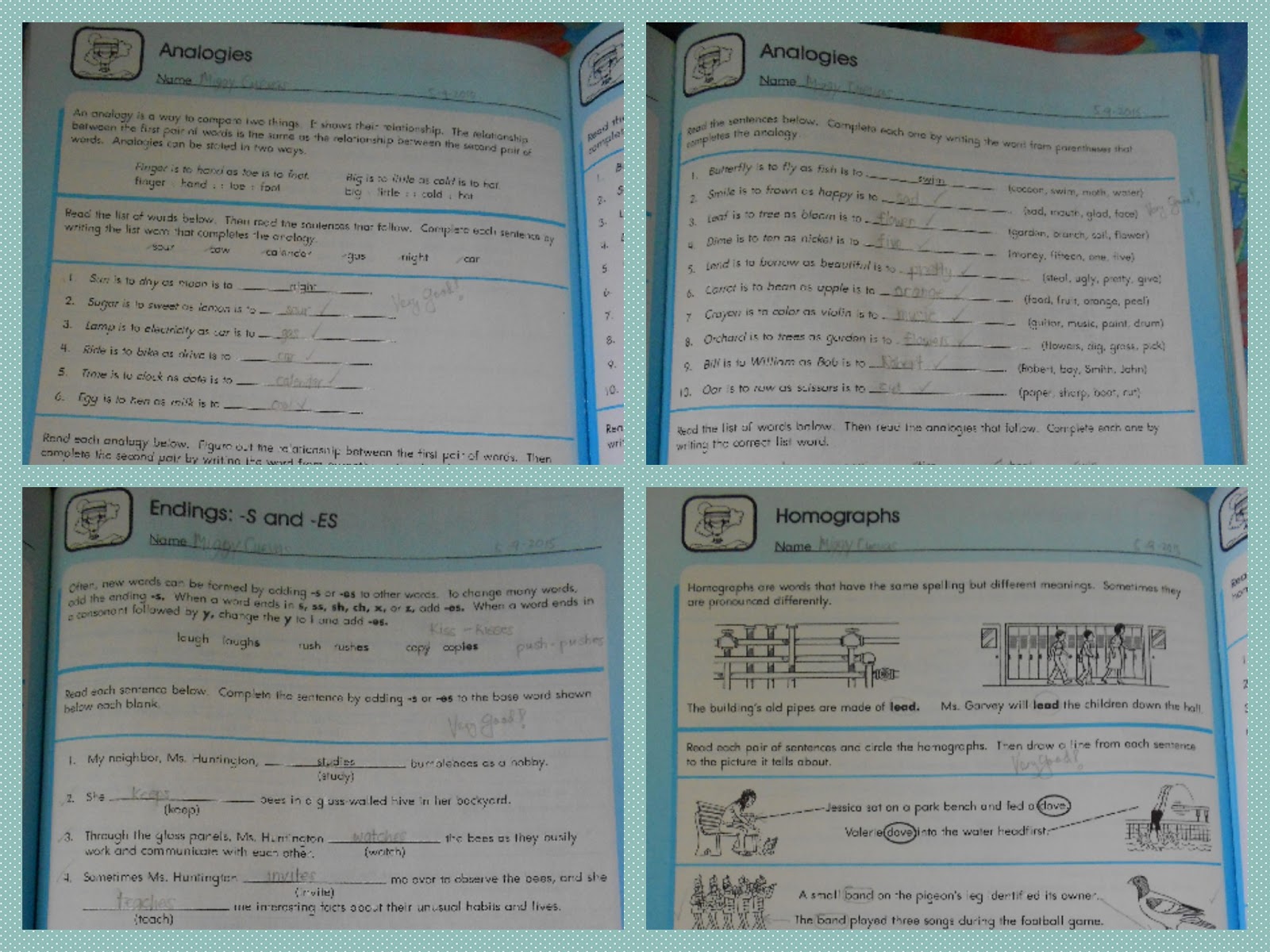
Word Study and Phonics


Math, inferences, sequencing, analogies, homographs, and spelling

While other kids are still enjoying their summer vacation, my Miggy here, as you can see, is doing academics. I'm preparing him now for the academic workload this coming schoolyear. Can't get idle for too long because it might trigger his disinterest.

18 April 2015

Word Find

Today's Mom session: Word Find
Miggy: This is too hard. Do this later, mommy.
Mommy: Don't stop. Finish 2 puzzles and I'll let you play.
Goal: To improve vocabulary and spelling, to increase attention span and improve concentration.


12 April 2015

Avengers Mug at Petron

Miggy: Mommy, this is for grade 6, the other one is for grade 7. Let's buy another one for grade 8.


(For release next week in Petron near BGH. Of course I begged.)


25 March 2015

Special Awards


Today, Miggy bagged two awards for being the Most Behaved, plus a Special Academic Award for schoolyear 2015-2016, grade 5 level. The recognition ceremony took place at the Baguio Country Club, Cameron Forbes Ballroom.

To Miggy, keep up the good work. Your Dad, Ate and I are with you every step of the way. Bear that in mind.
And to you Lord, again we thank you for the blessings.

14 March 2015

Cousins on the Spectrum


Kuya Tristan, Miggy's first cousin, also on the Autism Spectrum, went missing yesterday for 7 hrs. He escaped from former Woodway High School Campus on Thursday, 11:45 am. Thank God, he was found unharmed by community members in Seattle who helped with the search. Tristan is now with his family, completely unaware of the danger and the distress of the people who love him, especially my sister. If this happened in the Philippines, our police would have to wait for 24 hours missing period for action to be initiated. To my sister, Ate Etchie, rest and sleep now. It's over. Tomorrow will be beautiful and bright. Our prayers are with you and your family. Always.

MISSING TEEN WITH AUTISM FOUND IN SEATTLE

28 February 2015

K-Zone Cutouts


This explains his obsession for K Zone Magazines. He couldn't miss the monthly issues which are usually shown on TV before it comes out in the market.
"Mommy, let's buy K Zone in National Bookstore when we go to SM," he tells me persistently everyday until he gets it.

22 February 2015

The Unveiling

THE UNVEILING
No one knows why autistic children are often so beautiful, but it can be a great comfort to their parents.
"It is surprising fact that many - if by no means all - autistic children are exceptionally good-looking. Hans Asperger who published a pioneering account of autism in 1944, remarked on the ethereal beauty of his patients almost as if it were a diagnostic symptom. No one so far as I know, has yet advanced a hypothesis to explain this." -from the book GEORGE AND SAM by Charlotte Moore.


Yesterday, Feb. 21, 2015 was the Baguio launch of the Colors of "A" Coffee Table Book featuring 43 special participants since 2009 when the photography workshop started. Miggy joined in 2010 at the time he was only 7 years old. Today, Miggy is twelve and has participated in 5 workshops and photo exhibits held in SM Baguio City.


Add caption


The same day the book was launched, the photo exhibit opened in the basement, SM Art Gallery Art where participants' entries of the 2015 Photo Workshop at The Winaca Eco Cultural Village in Benguet were showcased. 


05 February 2015

My Lord is my Shepherd

This is Miggy's project in ESP 5, Psalms 23, The Lord is my Shepherd. Below is a collage of the procedure. I always take pictures of his school projects, academic and home activities, and behaviors which serve as my record/diary of what he could and could not do during a certain age. This way, I could monitor his development and plan ways on how to further improve him. The date imprint, as I always tell other parents, is a must. 


Parts of a Newspaper

 Filipino 5 requirement for the third grading period in Pines Montessori School. Mga Bahagi ng Pahayagan (Parts of a Newspaper).

01 February 2015

Teachers' Seminar on Autism Behaviors and Management at QHNHS


In celebration of the AUTISM Awareness Month and as preparation for the school's introduction of inclusive education in 2016 to students with disabilities, Quezon Hill National High School conducted a four-week seminar/workshop on SPED Program and Inclusion. I was invited to  lecture on Autism Behaviors and Management, share my first-hand experience with dealing with autism and the whats-and-hows of daily struggles with the disorder.

AS with my other lectures, Miggy's autism journey plays a significant part, inspiring everyone and giving hope that there is light after the grim diagnosis, that is, if all the efforts of parents, teachers, therapists and caregivers are put together towards opening new doors and exposing them to fresh possibilities, integrating them in today's more accepting society, and building the best possible outcome for all PWDs.

Miggy, today, is a regular fifth grader at the Pines Montessori School, top 7 in class, one of the youngest fine photographers in Baguio City. Although the autism journey is long, tough, and not without misses, failures and heartaches, still, we find it encouraging, fulfilling and best of all, FUN and FUNNY!

An add-in to my lecture yesterday was Aristotle's "As to the exposure and rearing of children, let there be a law that no deformed child shall live," in his book Politics. Similar to my initial reaction when I read that in Parallels in Time, my audience was surprised and dismayed, as expected. Who wouldn't be?!